The Platform
XOPS maintains the Position across the systems you already run, reconciles the evidence each decision depends on, and executes the governed outcome before drift becomes cost.
The core primitive
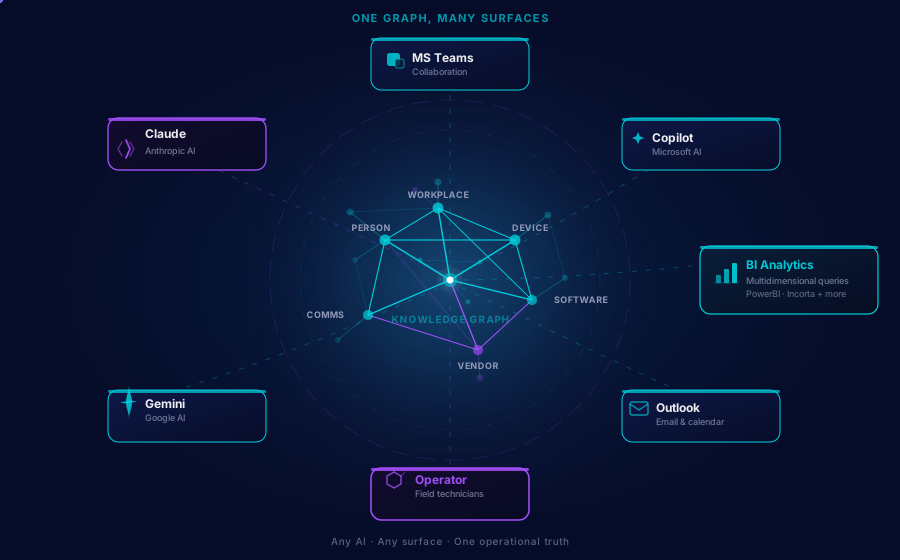
Employees. Devices. Software. Communications. Workplaces. Vendors. AI.
XOPS creates the reconciled Position across the systems that describe them.
A Position is the continuously maintained, decision-ready state of an entity, assembled from source-attributed evidence across the systems that each know part of it:
what the evidence says now, where it conflicts or remains unresolved, who owns it, what policy applies, and what should happen next.
The platform thesis
Kubernetes has a control plane. Cloud platforms have one. Network fabrics have one. Enterprise IT operations are a distributed system, and they've never had one.
You declare the desired outcome. XOPS maintains the Position and makes the enterprise converge on it: same input, same result, bounded, replayable, auditable. When enterprise reality changes, workflows create queues.
XOPS determines the governed action and executes it before drift becomes cost.
Shared state
The Position holds the decision-ready state.
Arbitration
Resolves conflicts. Reconciles drift.
Governed execution
Every action carries a compensation.
Reconciliation
Drift detected, drift remediated.
Cross-system execution
Your stack as actuators below one layer.
Workflows automate steps.
XOPS maintains the Position.
Seven domains today. One operating model everywhere.
Every domain reconciles evidence into a Position, evaluates it against a declared outcome, and executes the governed action. Same loop. Different entity.
Employee
Employee Position
Device
Device Position
Software
Software Position
Communications
Communications Position
Workplace
Workplace Position
Vendor
Vendor Position
AI
AI Position
AI is the newest Position in the same operating model.
The architecture
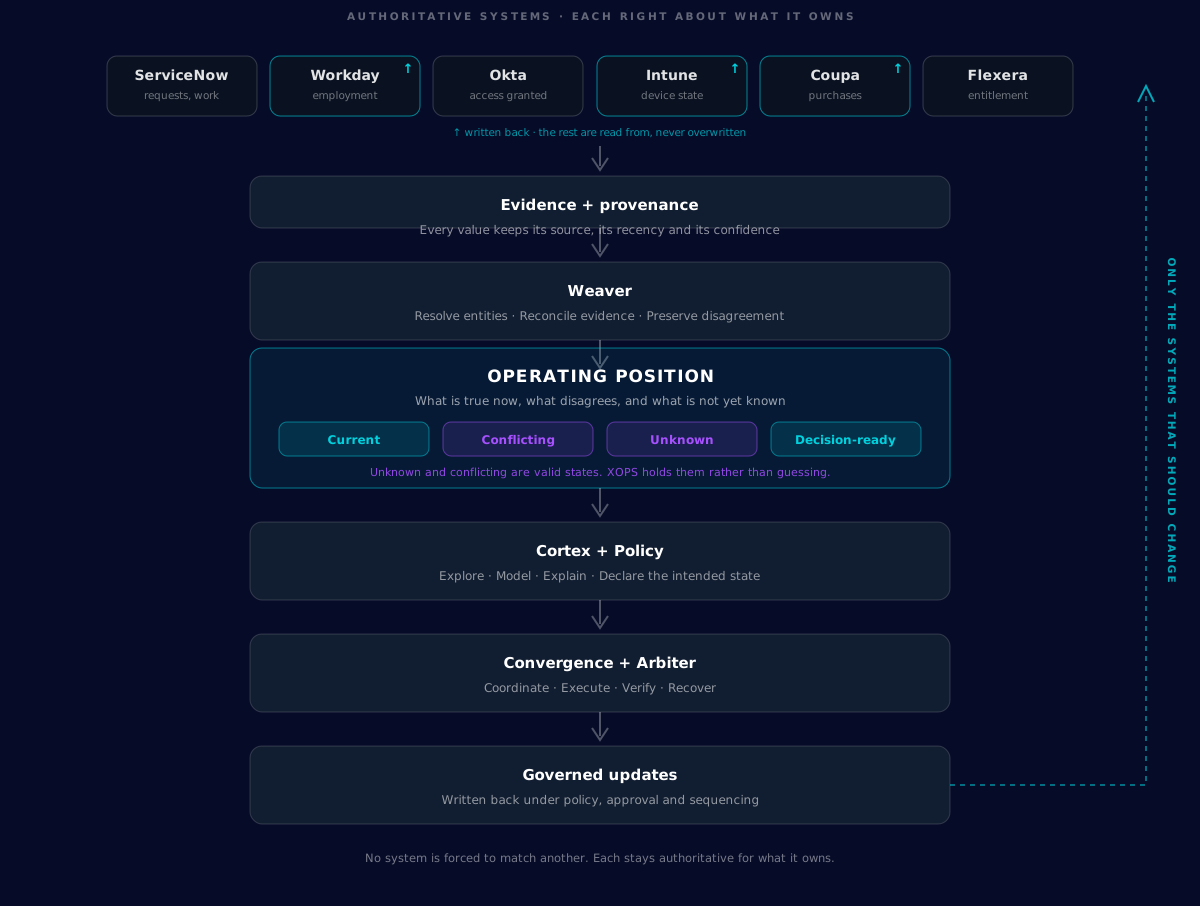
Your systems stay authoritative for what they own. XOPS reconciles their evidence into the Position, holds what it cannot resolve rather than guessing, and writes approved changes back only to the systems that should change.
Layer 1
Pre-loaded across seven domains. You don't define workflows. You declare the desired state, once, and the policy fires every time the data matches.
300+
Pre-built Outcomes
Layer 2 · The missing middle
This is where operational state compiles into action, through the graph and the capabilities that surround it. Weaver continuously reconciles telemetry from HR, Identity, Endpoint, Procurement, and ITSM into the Living Knowledge Graph, writing back to keep every system of record aligned.
That bi-directional life is what makes XOPS an intelligent layer rather than a passive integration.
Cortex exposes the reconciled Position through one governed interface: UI for operators, API for workflows, MCP for AI assistants. Convergence Engine turns declared outcomes into governed execution plans. Arbiter ensures concurrent changes resolve safely.
State
The Position
Plan
Convergence Engine
Define
Configuration as Code
Recover
Backstep Saga
Layer 3
Your HRIS, ITSM, MDM, SAM, and ERP report what happened. That is why we call XOPS a system of action: systems of record retain authority; XOPS governs what happens across them. We don't replace ServiceNow, Workday, Okta, Intune, or any other system. We make the stack you already own act as one.
And if a system isn't on that list yet? The Integration Factory lets XOPS or a partner build and plug in a new integration in days, not the next release cycle. Needing something new doesn't mean waiting for one.
The execution architecture
Not three layers stacked on top of each other. Three capabilities that work together to maintain the Position and execute the outcome. Click any to go deeper.
Systems of record
Stitches telemetry into the graph
Cortex
MCP access for AI & operators
Living Knowledge Graph
Continuously reconciled
Position
Declared outcome
Convergence Engine
Executes
Arbiter
Coordinates
Systems converge
Cortex doesn't touch systems of record. It sits above the graph, exposing what Weaver has already reconciled, via MCP.
Cortex exposes the current Position. Convergence Engine determines what should happen.
Arbiter ensures it happens safely when reality changes.
Capability 1 · Expose the Position
Cortex
The AI answer layer for your Position.
The AI interface into the Living Knowledge Graph. Weaver reconciles the evidence; Cortex exposes the resulting Position, through a governed MCP gateway, to AI assistants, operators, and workflows, resolved per entity, current as every system changes.
Explore Cortex →
Capability 2 · Execute the Outcome
Convergence Engine
Drives state convergence. Governed. Replayable.
Every Outcome compiles to one valid plan. Every state-mutating action ships with a compensation. The backstep saga unwinds partial failures cleanly.
Explore Execution →
Capability 3 · Coordinate Change
Arbiter
Resolves conflicts. Reconciles drift in flight.
When parallel events collide on the same identity, the Arbiter serializes the work. Concurrent writers commit as one transaction or none.
Explore Arbiter →
For CIOs & CFOs
A dashboard tells you what was spent. XOPS tells you who's accountable, and what should happen next, across every Position.
Unused software licenses reclaimed
Before the renewal, not after the audit.
Devices recovered before replacement
Performance-based, not calendar-based.
Mobile plans cancelled before billing cycles
Tied to the employee event that triggered it.
Vendor commitments aligned before renewal
Leverage assembled before the decision window closes.
AI spend attributed before invoice
Every employee assistant and every autonomous agent tied to an owner, a budget, and a cost center, the same Position discipline applied to your newest workforce.
What changes operationally
Architecture is the means. Operational state is the outcome. Once XOPS is running, the IT estate behaves differently, because the work resolves cleanly the first time.
Fewer conflicting transitions
Parallel events on the same entity serialize through the coordination layer instead of racing across systems.
Fewer state inconsistencies
Workday, Okta, ServiceNow, Intune. The record matches reality, continuously, not at the next reconciliation pass.
Reduced operational drift
Configuration as Code holds the declared state. Drift detected and remediated without a quarterly cleanup.
Lower coordination overhead
Operators stop stitching tickets across systems. They supervise the platform, not the queue.
Faster operational recovery
Every state-mutating action ships with a compensation. The backstep saga unwinds partial failures cleanly.
Governed AI execution
When AI assistants and agents act, they act through the same governed interface: every action auditable, reversible, bounded.
Deployment & domains
The work, onboarding a hire, refreshing a laptop, recovering a device, rotating a license, is the same at every Fortune 500. We've already built it. It ships pre-loaded. You don't have to do everything on day one, less invasive than most ServiceNow upgrades.
Pre-built Outcomes across
Employee · Device · Software · Communications · Workplace · Vendor · AI
The platform replaces the coordination layer
From declared outcome to coordinated production in under twelve months, without replacing the stack you already run.
Already running at Cencora · Corteva · S&P Global · Broadcom