The Platform / Domains / Device Lifecycle
XOPS maintains the Device Position and Fulfillment Position across the systems you already run. You declare the outcome; XOPS determines the governed action, executes it, verifies the result, and keeps the Position current as conditions change.
No new XOPS agent
Uses telemetry already deployed
Keep or evolve
Preserve your system of record or retire the discovery layer
Weeks
To first production Outcome
The category shift
XOPS is not another HAM platform.
It maintains the Device Position required to make lifecycle decisions.
You declare the outcome. XOPS continuously maintains the Device and Fulfillment Positions and acts until the estate converges.
Declared outcome
Defines the required end state
Every employee has the right device · Redeploy available inventory before buying · Refresh every device at the optimal economic point · Recover every company asset and preserve chain of custody
Technical Position
Health · Performance · Security · Compliance · Warranty
What condition is the device actually in?
Economic Position
Useful life · Repair cost · Replacement cost · Residual value · CapEx exposure
What is the economically correct decision?
Business Position
Owner · Role · Location · Criticality · Employee impact · Business intent
What does the business require from it?
DEVICE POSITION
Maintains the current state required to evaluate the gap to the declared outcome
Required action
Retain · Repair · Refresh · Relocate · Redeploy · Recover · Retire
FULFILLMENT POSITION
Continuously reconciled from inventory and logistics. Determines the best available path.
Autonomous execution
XOPS acts, observes the result, reconciles the new state, and continues until the outcome is achieved or a governed exception requires human action.
1. Asset records describe.
A Position decides.
Traditional HAM records ownership, lifecycle status, and location. XOPS reconciles the broader operating context and determines the required action.
2. Schedules generalize.
A Position individualizes.
A calendar says every device should be refreshed at the same age. XOPS uses the Device Position to determine the appropriate lifecycle action for each device.
3. Workflows route.
Outcomes converge.
A workflow moves a ticket through predefined steps. XOPS continuously recalculates the gap and adapts the required action and fulfillment path until reality matches the declared outcome.
4. Reports explain.
A Position acts.
A lifecycle report tells the team what to investigate. XOPS uses the same Device Position to reserve inventory, initiate recovery, choose fulfillment, update the CMDB, coordinate logistics, and file evidence.
XOPS operates autonomously toward declared outcomes. It continuously observes reality, determines the gap, selects the next action, executes across the connected systems, and verifies the result. Policies, constraints, approvals, and available execution paths govern every action. People engage only when judgment, approval, or physical work is genuinely required — in practice, roughly 92% of the device lifecycle runs end to end without a human touch. The remaining 8% is physical: someone still has to put a laptop in a truck.
Autonomy is not the absence of governance. It is governance that operates continuously.
Use the telemetry and systems you already own
XOPS does not need to become another endpoint management, inventory, ITSM, or logistics system. It continuously reconciles evidence already collected across DEX, MDM, EDR, HAM, CMDB, HR, OEM, procurement, inventory, logistics, and carrier platforms into the Device Position.
Keep and coordinate
Keep ServiceNow HAM or another asset repository as the system of record. XOPS maintains the broader Device Position, coordinates action across the surrounding systems, and writes the resulting state and evidence back.
Evolve the architecture
Where the enterprise already has sufficient device, inventory, employee, OEM, and logistics telemetry, XOPS becomes the continuously maintained decision and execution layer without requiring another discovery repository.
No new XOPS agent. No forced replacement. No workflow rebuild.
Smart Refresh™
A fixed-age policy assumes every device has the same useful life. XOPS continuously evaluates health, performance, failure risk, repair-versus-replace economics, employee impact, inventory, budget, and business intent to determine the optimal replacement point for each device.
Extend
Useful life extended where performance and economics support it
Pre-empt
At-risk devices refreshed before they disrupt the employee
Defer
Unnecessary CapEx deferred across each refresh cycle
Reduce
Fewer unnecessary replacements and less e-waste
Replace every device at the right time.
Not too late. Not too early.
Change the outcome, not the operating model
Finance declares a new outcome: consume pre-purchased inventory before approving net-new devices. XOPS automatically recalculates every affected Device and Fulfillment Position, rebalances refresh and inventory demand, and changes execution immediately. No workflow redesign, routing project, or operator retraining is required.
Change the outcome. The autonomous operating model adapts.
In production today
Customer outcome
Fortune 100 · Technology
At a Fortune 100 technology enterprise, Device Position replaced fixed-age refresh with performance and condition based decisions across 39 countries, right-sizing each refresh decision against the device’s actual performance, utilization, and compliance posture. Eligible devices remain in service one to two years longer where performance, security, utilization, and business need support it. The value appears in three places that matter to leadership: longer useful life, deferred CapEx, and reduced environmental impact.
+1–2 yrs
Average device life extended
CapEx
Deferred per refresh cycle
ESG ↑
Reduced e-waste & embodied carbon
“We used to staff for the seams: the people who knew which laptop went to which stockroom, which contract ended on which Friday, which executive was in which time zone. XOPS holds that context now. We staff for the work, not the coordination.”
Director of Workplace Tech · Fortune 100 Technology
1.4M+
Devices under continuous Device Position
39
Countries deployed
Weeks
Typical time to first production Outcome
Always-current device management views
The Device Position is not another dashboard. It is the continuously maintained evidence base behind every operational, financial, compliance, inventory, and executive view of the device estate. As device reality changes, every report changes with it.
The Device Position is the maintained operating state. These reports are the stakeholder-specific views published from it.
For ITAM & governance
Continuously maintained evidence of ownership, accountability, lifecycle controls, exceptions, remediation, chain of custody, and audit traceability.
For HAM & CMDB teams
Assigned owner, current location, lifecycle state, device health, warranty, compliance, discrepancies, and required correction.
For security & audit
Recovery status, custody handoffs, remote lock, sanitization and disposal evidence, exceptions, remediation history, and audit traceability.
For finance & procurement
Repair-versus-replace decisions, useful-life extension, forecasted refresh demand, CapEx exposure, avoided purchases, residual value, and budget exceptions.
For device ops & logistics
Available pools, profiles, regions, stockrooms, incoming demand, transfers, shortages, carrier status, and optimal fulfillment paths.
For leadership
Estate health, employee risk, refresh exposure, inventory utilization, recoveries, avoided spend, compliance exceptions, and decisions required for the next operating review.
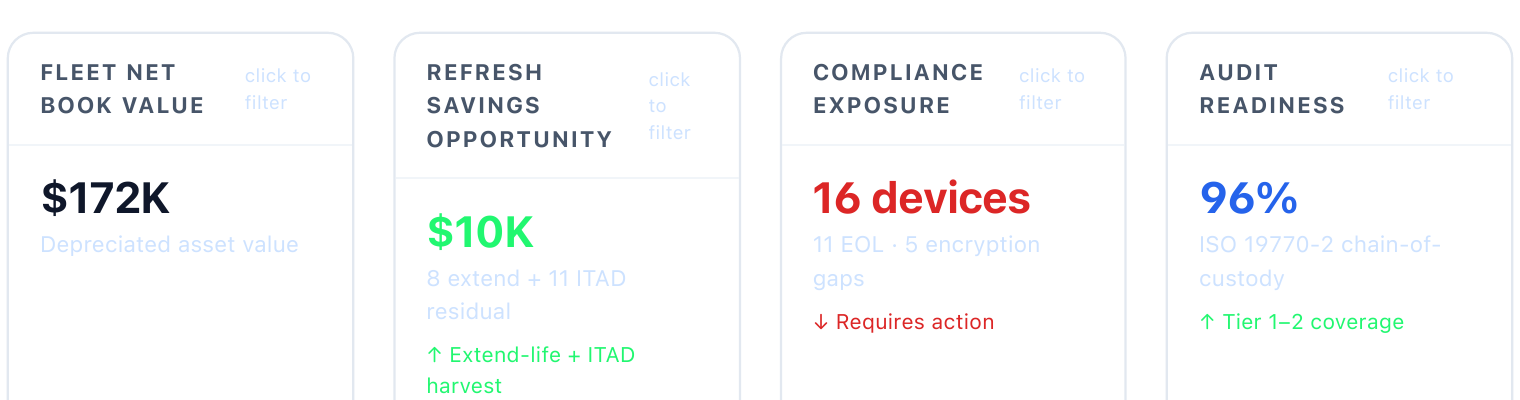
The executive device brief, live — net book value, refresh savings, and compliance exposure in one view.
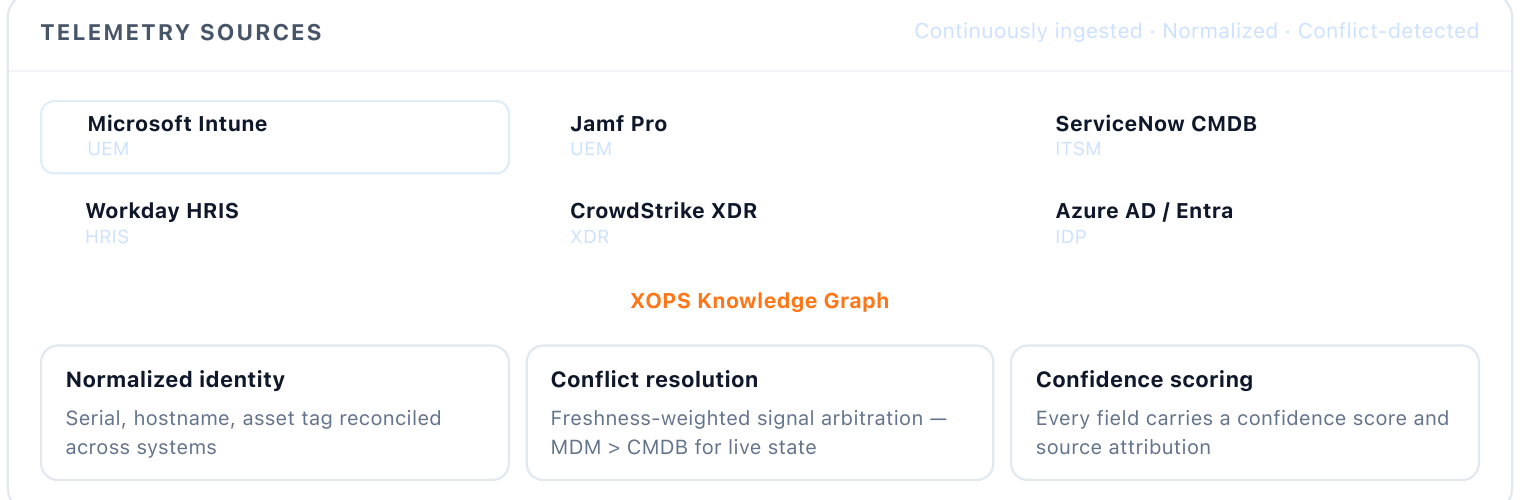
The CMDB reconciliation report’s source: six systems stitched into one authoritative device record.
Shown: XOPS Asset Intelligence, product demo.
One evidence base. Six management views.
Every action and report starts from the same Device Position.
Illustrative enterprise scenario
What happens after a device event
A workforce event updates the Device Position once. XOPS coordinates every consequence across identity, endpoint management, inventory, logistics, ITSM, procurement, the CMDB, and audit evidence.
Declared outcome
Recover every company device, preserve chain of custody, and redeploy available assets before purchasing another device.
$2,300
Replacement purchase avoided
Recovered
Asset, custody intact
Reconciled
CMDB, same event
Complete
Audit evidence
The event changed. The fulfillment path changed.
The declared outcome did not. XOPS continued operating until the estate converged.
Product depth
Forecast
Source
Stage
Deploy
Physical handoff
Operate
Refresh
Recover
Redeploy or dispose
8 stages, autonomous
1 stage, physical — a person still ships or hands off the device
One Device Position carries the device from hire to retirement. XOPS acts across every system involved (HRIS, MDM, IDP, supplier, carrier, stockroom, ITAD) without deploying a new agent, and autonomously executes the next action the moment the gap between reality and the declared outcome is clear. Every transition produces evidence — what changed, why, and under whose policy. What follows is that same Position, on one device, across one employee’s tenure: five moments, five different questions.
Stage 1 · Hire
Day 1
Trigger: A new hire lands in the HRIS with a role, a location, and a device policy attached.
XOPS decision: Matches policy to pool inventory, picks zero-touch or staged fulfillment, and sources new stock if the pool is empty.
Systems touched: HRIS, MDM, stockroom, supplier, carrier.
Evidence: Assignment and enrollment logged in the CMDB before the device ships.
Stage 2 · Operate
Ongoing
Trigger: A role change, a location change, a failed compliance scan, or usage that no longer matches the assignment.
XOPS decision: Reconciles the Device Position against current reality and resolves the gap directly, or raises an exception when policy requires a person.
Systems touched: UEM/MDM, identity, CMDB, security and compliance tooling.
Evidence: A CMDB record that stays current continuously, not just at audit time.
Stage 3 · Refresh
Month 18
Trigger: Battery health, performance, or warranty position crosses a threshold.
XOPS decision: Weighs performance, risk, economics, and business impact to decide refresh now or defer, and whether the recovered unit is worth refurbishing.
Systems touched: UEM telemetry, procurement, finance and lease data, stockroom.
Evidence: A refresh or deferral decision with the reasoning attached, not just a ticket.
Stage 4 · Recovery
Month 31
Trigger: A termination lands in the HRIS while the device is still assigned.
XOPS decision: Locks the device remotely, triggers recovery logistics, and routes it back through the shortest available path.
Systems touched: HRIS, MDM, carrier and logistics, CMDB.
Evidence: An unbroken chain of custody from termination to physical return.
Stage 5 · Retire
Day 3
Trigger: The returned device clears condition assessment as either redeployable or beyond refurbishment.
XOPS decision: Routes to sanitization and redeployment, or to ITAD for destruction, matching the outcome the Position already determined.
Systems touched: ITAD vendor, CMDB, compliance archive.
Evidence: Sanitization record or certificate of destruction, logged and closed out in the CMDB.
Use a 15-minute working session to select one declared outcome and the systems behind it. Then run it end to end before the next steering meeting.