Solutions / IT Asset Management
For ITAM directors, SAM managers, and HAM leaders
Discovery · Inventory · HAM · SAM · SaaS management
Contracts · Procurement · FinOps · Lifecycle
Each one knows its part. Your team still assembles the Position required to make the decision, every audit, renewal, reclamation and refresh.
XOPS maintains that Position continuously.
Software Position
Entitlement · Usage · Ownership · Cost · Contract · Renewal
Reclaim · Renew · Renegotiate · Prove
Device Position
Owner · Health · Warranty · Location · Lifecycle · Cost
Recover · Extend · Refresh · Dispose
What you have today
You bought them one at a time, each for a good reason, and each one is accurate about its own slice. What none of them was built to do is hold the combined state, so the last mile of every ITAM decision is a person with exports and a spreadsheet.
The tools scale. The person doesn't.
Add a tenth product and you have added a tenth source to reconcile, not a tenth of the work removed. Coordination is the constraint, and it is the one thing none of these products sells.
The audit didn't create the work. The drift did.
Most of what an audit costs is not the settlement. It is people rebuilding a Position that should never have been allowed to decay, under a thirty-day clock, from the same nine products.
Where the asset record stops
“My inventory is incomplete.” “My CMDB, UEM, and SAM views conflict.” “I can’t trust the data enough for an audit, a renewal, or a refresh decision.” Fragmented ownership, decentralized procurement, shadow IT, and SaaS sprawl mean no single system reconciles the estate continuously — including the unmanaged, unsupported, exception, and end-of-life assets that never make it onto a clean report.
The software record is not the Software Position.
A SAM tool may know what was purchased or discovered, but not necessarily what is currently used, contractually exposed, renewal-critical, or ready for action.
The device record is not the Device Position.
A CMDB or UEM may know that a device exists, but not whether it should be extended, repaired, recovered, reassigned, refreshed, or disposed.
The report is not the maintained state.
An ELP, refresh list, or audit response is an output from the Position. It should not require the Position to be rebuilt each time.
Systems of record tell you what they recorded.
Software Position and Device Position tell you what is true now and what should happen next.
The next operating model
ITAM 1.0 recorded the estate. ITAM 2.0 optimized it.
ITAM 3.0 operates it.
The tools you already own are not broken. The operating model around them stops at the finding. Someone still has to reconcile the systems, decide what holds, carry the work across the handoffs, and confirm the intended state actually happened. ITAM 3.0 removes that reassembly.
ITAM 1.0
Record
What do we have?
Systems record what exists.
Inventory, discovery, the repository. Know what you have. Necessary, and where most ITAM programmes started.
ITAM 2.0
Optimize
Where is the waste and the risk?
Tools identify cost, utilization and risk.
Understand utilization, licensing, cost and exposure. Then hand the finding to a person to assemble, defend and act on.
ITAM 3.0
Operate
What should happen, and did it?
The estate is maintained as a Position and the lifecycle runs across the handoffs.
Owned, used, paid for, entitled, and what to do next. Humans set policy and handle exceptions. The estate stops being reassembled.
You do not have to climb it in order
These are three operating models, not three maturity gates.
A programme still operating at 1.0 does not have to build 2.0 first and then replace it. XOPS adds no discovery layer and requires no effective license position to already exist, and where the evidence is insufficient the Position says so rather than guessing.
The incumbents help you understand pieces of the estate. Maintaining its state is a different job, not a better tool.
Why this is changing now
Gartner
Organizations mistakenly overestimate the capabilities and the automation a SAM tool will deliver.
How to Select the Right Software Asset Management Tools, Kalay and Harris, March 2024.
Deloitte
Manual and partially automated ITAM processes cannot keep up with the scale, speed and complexity of today’s estates.
Global IT Asset Management Survey 2025, which also finds fewer than 40% of organizations have fully adapted ITAM processes for hybrid environments.
Forrester
Autonomous operations for most processes are a North Star for many enterprises, and deterministic workflow engines, RPA and DPA are not powerful enough to get there.
Bernhard Schaffrik, Announcing The Evaluation Of The Adaptive Process Orchestration Market, September 2025.
None of these firms calls this ITAM 3.0. We do.
Read together, they describe the same transition from three directions: tools that record and optimize parts of the estate, and no operating model that maintains and acts on the whole. The name is ours. The requirement is not.
Read the evidence: The Need for ITAM 3.0Gartner, Deloitte and Forrester do not endorse XOPS and do not use the term ITAM 3.0. Their research is cited here as independent description of the conditions, not as validation of this platform.
What changes
Flexera, ServiceNow, Snow, USU, Lansweeper and Intune do the jobs they were designed to do. Nobody owns what happens between them.
| ITAM 2.0 | ITAM 3.0 | |
|---|---|---|
| Primary job | Record and optimize | Maintain and operate |
| State | Reassembled when needed | Continuously reconciled |
| Automation | Inside tools and workflows | Across the estate |
| Human role | Reconcile and coordinate | Judge exceptions |
| Output | A finding or a recommendation | A verified outcome |
| What holds | Multiple views of the estate | One governed Position |
The tools are getting better. The operating model is still falling behind.
The full ITAM 3.0 guide: ten differencesThe operating model
Software Position
Evidence
Entitlement · Contract and licensing metric · Installation · Assignment · Usage · Employee state · Cost · Compliance · Renewal exposure
Actions
Reclaim · Reassign · Renew · Renegotiate · True-up · Remediate · Retire · Prove
Device Position
Evidence
Device identity · User and owner · Location · Performance · Security · Management state · Warranty · Age · Recovery · Repair · Refresh · Disposition
Actions
Recover · Reassign · Repair · Extend · Refresh · Replace · Remediate · Dispose
The newest asset class
For ITAM, AI expands the technology estate. AI seats, tokens, API keys, models and autonomous agents create new entitlement, consumption, ownership and lifecycle questions that ITAM increasingly has to govern. Agents behave differently from traditional software assets, but they still consume technology, spend and authority that must be accounted for. The difference is that they provision themselves between your inventories.
What the Position surfaces
What XOPS does about it
The principle
No invented people. No dropped dollars.
Every unit of consumption resolves to a person or an agent, or is explicitly held as unresolved. XOPS will show an ITAM leader a gap before it guesses an owner, because a guessed owner is what makes a chargeback indefensible.
Our newest lifecycle: specified and in early deployment. The production proof at scale is in software, device and employee.
Where the evidence lives
ITAM data is split across SAM, CMDB, UEM, SaaS admin consoles, procurement, contracts, and identity — plus the cloud and AI spend most of those systems were never built to see. No one system reconciles it continuously, which is exactly what drives SaaS sprawl, decentralized buying, and shadow IT.
People & org
HRIS · Identity · Directory
Software
SAM · Discovery · Usage telemetry · SaaS admin
Devices
UEM · MDM · DEX · EDR · CMDB · OEM
Commercial
ERP · Procurement · Contracts · Entitlements · Renewals
Operations
ITSM · Logistics · Depot · Repair · ITAD
Existing systems
Software and Device subgraphs
Software Position and Device Position
Governed actions and stakeholder views
No rip-and-replace. Read-only to start.
Your SAM and HAM systems coexist with the Position. They are not replaced by it.
That includes the tooling you are contractually obliged to keep. Publisher-mandated measurement, IBM sub-capacity and the like stays exactly where it is: XOPS consumes its output as evidence rather than replacing it, and deploys no proprietary agent to the endpoint.
What you already have
XOPS reconciles
No new endpoint agent
Software Position
ELP · Renew · Reclaim
Device Position
Recover · Extend · Refresh
Keep your existing SAM, CMDB and UEM tooling. XOPS can consume the ELP you already produce, or maintain the Position directly from the underlying evidence, and keeps the CMDB current for software and hardware rather than whichever was audited last.
Published from each Position
From the Software Position · SAM
Entitled vs. measured vs. actual usage, current at any moment, not rebuilt each cycle.
Unused, orphaned, and misassigned licenses identified and routed for action as the Position changes.
Contractual exposure and true-up risk visible ahead of the renewal window, not discovered inside it.
Entitlement-to-usage variance maintained per publisher, defensible before the vendor raises it.
From the Device Position · HAM
Who has the device, where it is, and whether the record still matches reality.
Refresh decisions driven by actual health and performance, not a fixed age policy.
Devices recovered and reassigned as employment and ownership status change.
Recovery, sanitization, and disposal evidence preserved for every device that exits the fleet.
Across both Positions
Stakeholder decision views
ITAM sits between procurement, finance, security, endpoint, and operations — and governance gaps open exactly at those seams, where each team updates its own systems and no one reconciles the whole.
SAM leader
ELP, publisher exposure, reclamation, renewal posture.
HAM leader
Ownership, health, recovery, refresh, disposition.
Procurement
Entitlement, usage, renewal exposure, negotiation evidence.
Finance
Cost exposure, savings opportunity, TCO, forecast.
Security & compliance
Unmanaged, unsupported, unencrypted, non-compliant assets.
Leadership
Portfolio health, financial exposure, risk, exceptions, action progress.
Every view above draws from the same evidence base — mapped to ISO/IEC 19770, source-attributed, reconstructable for any prior date, and inclusive of disposal and sanitization records — so audit response, renewal defense, and true-up positions start from evidence an auditor would accept, not a report rebuilt for the occasion.
Illustrative scenarios
Two Positions in motion
Software Position · an employee leaves
Nobody filed a ticket.
The Position noticed, recommended, and followed the approved control.
Device Position · a laptop hits the calendar
The calendar said replace it.
The Position knew better, and proved it.
Customer evidence
Software Position proof
Fortune 250 financial services, anonymized
A Fortune 250 financial-services customer shifted from quarterly ISO 19770 audit preparation to a continuous-readiness posture. Microsoft ELP variance analysis surfaced over-licensing defensible enough to enter the renewal cycle as leverage, not an apology.
$1.7M+
Over-licensing identified
22 / 22
ISO 19770 areas covered, observed
974
Software-user pairs, usage confirmed
96%
Audit readiness, observed
Device Position proof
Fortune 100 technology, anonymized
A Fortune 100 technology enterprise shifted device refresh from a fixed-calendar trigger to a performance-and-condition trigger across a global fleet, right-sizing each decision against the device’s actual health and business need.
1–2 yrs
Device life extended, observed
39
Countries deployed, observed
Reduced
Ghost-asset exposure, observed
$4.3M/yr
Refresh saving, observed
Each figure is labeled where it stands: observed in production, or identified. Your numbers will vary, and we’ll measure them with you.
The product behind these numbers
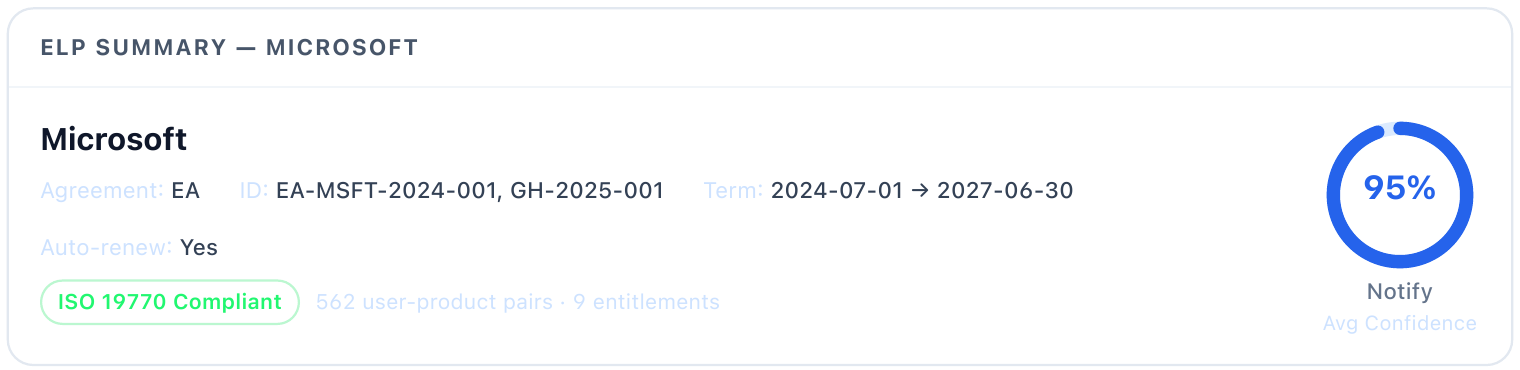
The Effective License Position behind the $1.7M figure above.
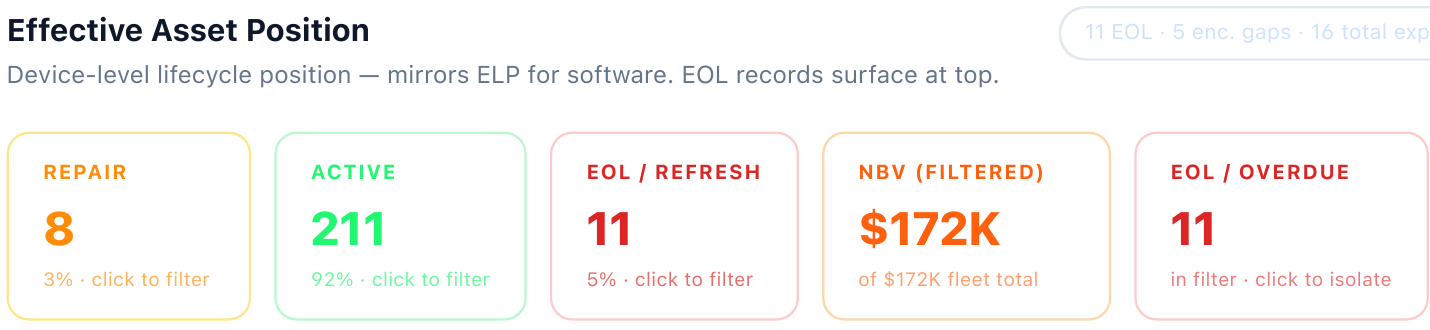
The device-side mirror of the same model.
Shown: XOPS Asset Intelligence, product demo.
How adoption actually works
1
A renewal, a refresh cycle, or an audit on your calendar in the next two quarters.
2
SAM, CMDB, UEM, HRIS, and identity. Least privilege. Nothing written back without approval.
3
Software Position or Device Position, reconciled into one continuously current state.
4
ELP, refresh list, or audit response, evidence-backed and ready before the deadline.
For ITAM, SAM, and HAM leaders
Choose one publisher, one device cohort, or one lifecycle decision. XOPS connects the relevant evidence, assembles the Position, and shows what is true, what is exposed, and what should happen next.
Software Lifecycle data sheet · Device Lifecycle data sheet
Your SAM and HAM systems remain the systems of record.
XOPS maintains the continuously reconciled Positions required to act.
Software Position and Device Position are two views of one Operating Position, the same model that carries employee, vendor and AI. See how the Position works →