XOPS

AI & Agent Governance agent

Your AI budget has owners. Does your AI spending?

Employees, agents and automated jobs are consuming models, tokens and seats across your enterprise. Most companies can’t connect that spend to a person, a budget or the authority granted.

The AI & Agent Governance agent continuously reconciles your AI estate across the providers you connect. It attributes every dollar to a person, an agent and a cost center, or holds it explicitly unnamed rather than guessing. It holds every agent to the authority it was granted, forecasts each budget and enforces the limits you set, before the bill arrives.

Every agent owned. Every action authorized. Every exposure bounded.

Works for: FinOps, IT, security and procurement leaders who own AI spend and risk

Five AI consumers. One bill. Illustrative.

Your AI budget has owners. Does your AI spending?Five AI consumers: an employee’s assistant seat, a sales assistant agent, a data enrichment job, an agent whose owner has left and an unregistered AI tool. Without XOPS, their spend flows into one AI bill with nearly a third of it tied to no owner, found at month end. With XOPS, each one is attributed to an owner and cost center and held to policy: within budget, warned at 80 percent, throttled at its limit, suspended for the manager to reassign, or held unnamed with shadow AI escalated, so the budget is forecast before the bill arrives. Figures are illustrative.Employee · assistant seatSales assistant agentData enrichment jobAgent of a departed ownerUnregistered AI toolseat · no budget linkowner unknownno limit setkey still validnobody registered itAI BILL$412K31% with no ownerfound at month endMaya Chen · MarketingWithin budgetOwner J. Ortiz · SalesWarned at 80% of budgetAnalytics · job limit $9KThrottled at its limitOwner left FridaySuspended, manager to reassignNo owner on recordHeld unnamed, shadow AI escalatedAI BUDGETForecast within budgetEvery dollar named,or held unnamedbefore the bill arrives
Every consumer is real spend. Almost a third of it has no owner, and nobody finds out until the bill.Every consumer attributed and held to policy, so the budget is forecast before the bill arrives.

Watch the AI & Agent Governance agent work

The agent is already working.

Why this needs an agent

One operating model. Two workforces.

An autonomous agent authenticates into your systems, spends budget and acts on delegated authority without a person in the loop. That makes it a worker, not a tool, and it needs the same management a person gets.

Human workforce

Autonomous workforce

Employee identity

Agent identity

Manager

Accountable owner

Role

Declared scope

Budget

Budget

Approval authority

Delegated authority

Onboarding and offboarding

Provisioning and retirement

The full argument: The Autonomous Workforce

What the AI & Agent Governance agent delivers

Knowing who spent the money doesn’t stop the next overrun.

Visibility tools report the spend. XOPS controls it: it enforces consumption limits, restricts permitted models, throttles usage, suspends access and routes exceptions for approval, through governed execution.

Attribute

Every dollar named to a person, an agent or a cost center, or held explicitly unnamed. Never guessed.

Forecast

Projects every budget forward, so an overrun is visible days before the invoice, not at month end.

Enforce

Warns, throttles and suspends at the limits you set, and holds each persona to its permitted models, through governed execution.

Govern the lifecycle

When an owner leaves, their agents are reassigned or retired and their keys revoked or rotated.
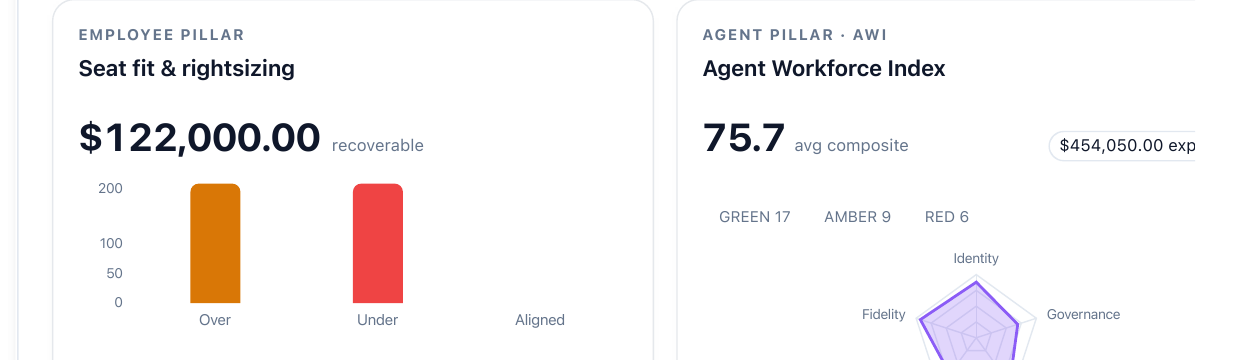
XOPS AI Portfolio view: recoverable seat spend and the Agent Workforce Index across green, amber and red agents
Every agent priced, scored on the Agent Workforce Index and attributed to an owner. Shown: XOPS product demo.

Illustrative scenario

One AI job. Three days. A third of the monthly budget.

An employee launches a resource-intensive AI job. Consumption accelerates, and the budget owner has no idea until the spend is already committed. With XOPS, the spend is attributed to the employee and cost center as it happens, projected against the budget, and held to your warn, throttle and suspend policy.

One AI job. Three days. A third of the monthly budget.Cumulative spend of one AI job over six days. Without XOPS it reaches a third of the monthly AI budget by day three and is found at month end. With XOPS the owner and budget holder are warned on day one and the job is throttled at its limit, with any further spend needing approval. Illustrative.Day 0Day 1Day 2Day 3Day 4Day 5Day 6A third of the monthly AI budgetWithout XOPS: found at month endDay 1: owner and budget holder warnedThrottled at the job’s limit; more needs approvalWith XOPS

How a limit is enforced depends on the provider: its native quotas, throttling, or suspending access. Each connected provider uses the controls it supports.

Visibility tells you after. Control stops it during.

Illustrative scenario

An employee leaves Friday. Their AI agent keeps spending Monday.

Without the agent

  • HR processes the termination and identity deprovisions the person.
  • The agent they owned keeps running on a valid API key, funded by its budget.
  • At quarter close, finance finds spend against a cost center whose owner left months ago.

With the agent

  • It finds every assistant, key and agent the employee owned, with current spend.
  • The manager gets one decision: reassign the agent or retire it.
  • XOPS executes it across HR, identity and finance, and the agent verifies the key is revoked or the ownership moved.

One departure. Nothing left spending in the dark.

Jordan Lee leaves on Friday

  • Workforce Lifecycle ManagerRecords the departureDone
  • Jordan’s managerA person decidesDecides: reassign two agents, retire oneDecided
  • Software Asset ManagerReclaims the Copilot seatDone
  • FinOps agentMoves the remaining spend to the new owners’ cost centers and updates the forecastDone
  • AI & Agent GovernanceOwns the outcomeFinds three agents, four API keys and two assistants Jordan owned, with their spend and permissions, then revokes or rotates the keys and verifiesExposure closed

✓ Nothing left spending, or acting, on a departed owner’s authority

Illustrative.

Its authority

What it does on its own. What it asks you first.

Does on its own, within your policy

  • Enforces spending limits through supported provider controls, throttling or suspending consumption when thresholds are reached
  • Revokes or rotates keys whose owners have left, where the provider allows it, and opens a governed remediation where it doesn’t
  • Reclaims AI seats nobody uses

Asks before it acts

  • Funds spend above an agreed budget
  • Reassigns an agent to a new owner
  • Grants a persona a new model or provider

Escalates to your team

  • Shadow AI usage outside approved providers
  • Consumption spikes your policy does not cover
  • Agents acting outside delegated authority

You set the autonomy level for each play, from recommend-only to run within policy.

Agents run the job. XOPS executes the actions. People set the policy and own the exceptions.

How personas and the Agent Workforce Index work

Personas. Every employee maps to a persona: the models and tools they may use, a monthly budget, warn, throttle and suspend thresholds, and an autonomy ceiling for the AI acting on their behalf. Limits are set once on the persona and enforced for everyone mapped to it.

Autonomy ceiling. L1 drafts and recommends while a person executes. L2 executes routine actions in scope and routes exceptions. L3 executes broadly within policy, reviewed continuously.

Agent Workforce Index. Every autonomous agent is scored on efficiency, identity, economic fit and fidelity, and banded green, amber or red, so the lowest scores reach their owners first.

Built for the real stack

Your AI estate spans providers. Your governance shouldn’t.

4

Providers supported today: Anthropic, OpenAI, Google and Microsoft

200+

Connecting AI consumption to identity, HR, finance and enterprise operations

Continuous

Enforcement, not alerts after the fact

ISO 42001

Certified AI management system

What is the maximum exposure of any single AI agent you run?

Start with one department, one agent framework or one AI vendor renewal. Discovery starts read-only; enforcement uses the permissions you grant for each provider.

AI governance data sheet