The Platform / Domains / AI Workforce Operations
Every dollar and every seat of AI consumption belongs to a person or to an agent. The hard part is knowing which — across every vendor, without dropping consumption or inventing an owner.
XOPS can.
One question, asked of every AI meter: who consumed this?
AI Workforce is one domain of the XOPS operating model: the same Position architecture and organizational spine, applied to people, autonomous workers, consumption, ownership, budget and delegated authority.
Two workforces
People and agents, two consumers, never blended on one fact
Every meter
The same question asked of every vendor, one grain
Nothing dropped
Unnamed spend stays in the total until it can be named
One graph
Person, agent, seat, key, department, device — one model
The category shift
Every previous technology wave gave employees better tools.
AI created an entirely new workforce.
Technology used to change how work was performed without changing who performed it. An autonomous worker is different: it authenticates into enterprise systems, consumes budget, acts within delegated authority, and triggers downstream work without a human in the loop. A chatbot answering questions on demand is still a tool. This is not.
Two workforces is the reason. It is also what makes the counting possible: if there are two workforces, every unit of AI consumption ultimately belongs to one of two consumer classes — a person or an agent. Until the evidence proves which, XOPS holds it as unnamed rather than guessing.
This is not fundamentally a technology problem. It is a management problem.
This argument is set out in full in The Autonomous Workforce, a thought leadership paper by Pat Calhoun, Chief Commercial Officer at XperiencOps.
XOPS maintains the Operating Position across your systems.
AI Workforce Operations is how it governs both workforces.
XOPS maintains the live AI Position of every employee and every autonomous worker: the same identity, accountable owner, declared scope, budget, delegated authority, and lifecycle primitives, applied identically to both workforces and attributed to one org spine.
Human workforce
Autonomous workforce
Employee identity
Agent identity
Manager
Accountable owner
Role
Declared scope
Budget
Budget
Approval authority
Delegated authority
Onboarding
Provisioning
Transfer
Reassignment
Offboarding
Suspension or retirement
Performance
Cost and business value
Declared outcome
Every seat and every autonomous worker stays inside its budget, inside its delegated authority, and attributed to a real owner.
Employee AI Position
Persona · Models allowed · Tools allowed · Monthly budget · Autonomy ceiling · Warn / throttle / suspend thresholds
Agent Workforce Position
Identity · Owner · Cost center · Budget · Tokens · Agent Workforce Index · Autonomy ceiling
ONE ORG SPINE
Department · Cost center · Region
Governed action
Warn · Throttle · Suspend · Reassign · Reclaim · Fund
Illustrative scenario
When the owner leaves
Here is one edge, followed end to end. XOPS already knew Employee A owned Agent X, that it runs on API Key K, bills to Cost Center C, spends about 2.3M tokens a day against an $8,000/month budget, and reports to Manager B.
Without a Position
With XOPS
One departure. Every assistant, key, and agent accounted for.
Nothing left spending in the dark.
What the Position guarantees
Some AI consumption resolves cleanly to a person. Some resolves to an agent. And some, on the day you look, resolves to neither — a shared key, a team account, a vendor line with no identity attached. XOPS holds that spend in the total and labels it unnamed rather than dropping it or assigning it to the nearest plausible owner. It stays visible, and it shrinks as evidence arrives.
No invented people. No dropped dollars.
That same Position is a live answer, not a record: who consumed this (a person, an agent, or explicitly unnamed — never merged onto one fact); against which budget (warn, throttle, and suspend thresholds evaluated as consumption happens, not reviewed at month end); on whose authority (every agent and key resolved to an accountable human and a cost center, or held explicitly ownerless); and what happens next — reassign, reclaim, throttle, retire, or fund, with ownership, budget, and policy moving together across HR, identity, and finance because the estate is one model.
Not a concept. A screen.
The Agent Consumption view inside XOPS Experience Center: every agent priced, scored, and attributed to an owner — or explicitly held as ownerless — live.
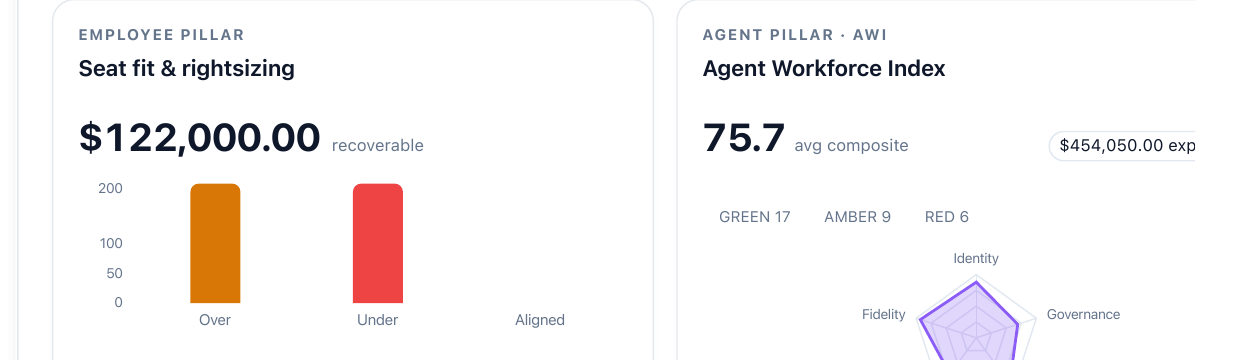
Shown: XOPS Asset Intelligence, product demo.
The employee AI estate
A persona is an entitlement catalog, not a budget line. It defines which models an employee may use, which tools they may reach, what their monthly budget is, and how much autonomy their AI assistant is allowed to exercise on their behalf. Limits are defined once on the persona and enforced for every employee mapped to it.
Executive
Autonomy L3Models
Claude Opus · GPT-5.1
Tools
Claude for Work · ChatGPT Enterprise · Microsoft 365 Copilot
Monthly budget
Not set
Warn
75%
Throttle
90%
Suspend
—
Manager
Autonomy L2Models
Claude Sonnet · GPT-5.1 Mini · Copilot M365
Tools
Claude for Work · Microsoft 365 Copilot
Monthly budget
$1,000/mo
Warn
80%
Throttle
95%
Suspend
100%
Security Analyst
Autonomy L2Models
Claude Sonnet · GPT-5.1
Tools
Claude for Work · ChatGPT Enterprise
Monthly budget
Not set
Warn
70%
Throttle
90%
Suspend
—
Finance Analyst
Autonomy L1Models
GPT-5.1 · Claude Sonnet
Tools
ChatGPT Enterprise · Claude for Work
Monthly budget
$700/mo
Warn
80%
Throttle
95%
Suspend
100%
Illustrative persona configuration from a live product view. Models, tools, budgets, and thresholds are configured per organization.
Autonomy ceiling is not a model choice. It is a governance decision.
Everyone talks about which models an employee may use. Very few enterprises are talking about how much authority the AI acting on that employee's behalf may exercise without a human in the loop. The autonomy ceiling makes that decision explicit, per persona, and enforces it continuously.
Supporting evidence · the agent workforce
Every autonomous agent is scored across four dimensions and banded green, amber, or red — the same governance discipline behind the persona system above, applied to the agent side of the estate.
The Index scores four dimensions: efficiency (value produced per dollar and per token spent), identity (whether the agent resolves to a real owner and cost center), economic fit (spend against budget and expected demand), and fidelity (whether it operates within its declared scope).
The same autonomy ceiling that governs personas applies here — how much authority an agent may exercise, not just which model it runs: L1 drafts and recommends, a human executes every action; L2 executes routine actions within scope and routes exceptions to a human; L3 executes broadly within policy, reviewed continuously against the Index.
Priority actions
What XOPS surfaces automatically, ranked lowest Agent Index first and routed to the owner, without a manual review cycle.
Support Triage Agent 030
Agent workforce risk: review governance, scope, and economic alignment.
Security Ops Agent 015
Agent workforce risk: review governance, scope, and economic alignment.
Support Triage Agent 010
Agent workforce risk: review governance, scope, and economic alignment.
Illustrative product view. Agent names and scores are representative of a live governance workspace.
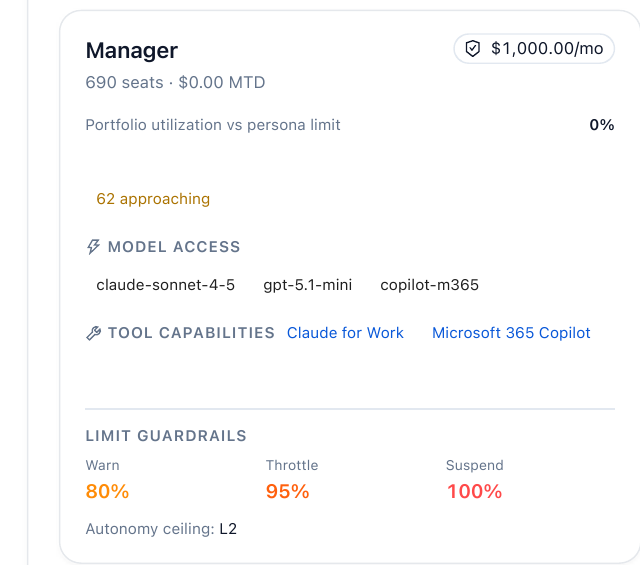
Enforce persona guardrails.
Shown: XOPS Asset Intelligence, product demo.
The operating model
An autonomous workforce requires an operating model, not another technology platform. Every autonomous worker should be discoverable (found because it is consuming, not because someone registered it), accountable (resolved to a named human when the evidence is clean, or held ownerless until it can be — never guessed), authorized (operating inside a declared scope and an autonomy ceiling someone consciously set), bounded (a budget with warn, throttle, and suspend thresholds that fire, the same way a spending limit binds an employee), and continuously evaluated on identity, scope, economics, and fidelity — and on whether the work is worth what it costs. Visibility delivers the first. It does not deliver the other four.
Identity systems govern credentials. AI platforms manage models and execution. Cost systems monitor consumption. Security evaluates risk. Each solves a fragment; none of them was designed to operate a workforce.
Boards spent a decade asking about cloud strategy and security posture — questions about technology investment. The next set is different: how many autonomous workers operate across the enterprise, who owns each one, what decisions they are authorized to make, what financial authority they hold, what prevents uncontrolled spending, and whether they create measurable value. The one most enterprises cannot answer today is the sharpest of the six: what is the maximum financial exposure of any single autonomous worker? A human employee has an approval limit and a spending authority, both written down and enforced. An autonomous worker consumes budget continuously and, in most enterprises today, has neither. XOPS maintains that ceiling per worker, per persona, and per cost center — enforced continuously, not reviewed at month end.
Enforcing it requires asking every meter the same question at the same grain. Each AI vendor exposes its own console, its own object model, and its own idea of a user; modeling each one separately produces a page of numbers that cannot be added together. XOPS asks three questions of every surface instead: the seat — an entitlement someone holds, is it used; the token — activity actually emitted, by whom; the dollar — what was billed, against which consumer. Runtime is not inventory: an application record says something was registered, a runtime consumer says something is spending right now under someone’s authority, and treating those two lists as the same story is how agents go unowned.
A person owns an agent. An agent runs on a key. A key outlives the person. A seat is an entitlement, not a consumer. Those joins are the product: holding them on one model is what lets a single decision travel — retire an agent and the key is revoked, the budget released, the showback corrected, and the manager notified, because they were never separate records.
A spreadsheet of spend cannot do these joins. Neither can a view built on one vendor’s own object model.
Rightsizing
The same discipline that rightsizes software licenses and device fleets now applies to AI seats and agents, routing every over-provisioned entitlement to an owner for action.
Zombie entitlement
Licensed or assigned, with no real use behind it. Reclaim is an action on the estate, not a line in a report.
Role fit
What the person is entitled to, against what they actually use. The gap is recoverable demand, quantified per persona.
Redundant assistants
The same persona entitled to overlapping tools doing one job. Redundant spend looks like productivity until the use is compared.
API keys don’t get offboarded when an employee leaves. XOPS finds every credential still active after its owner has departed.
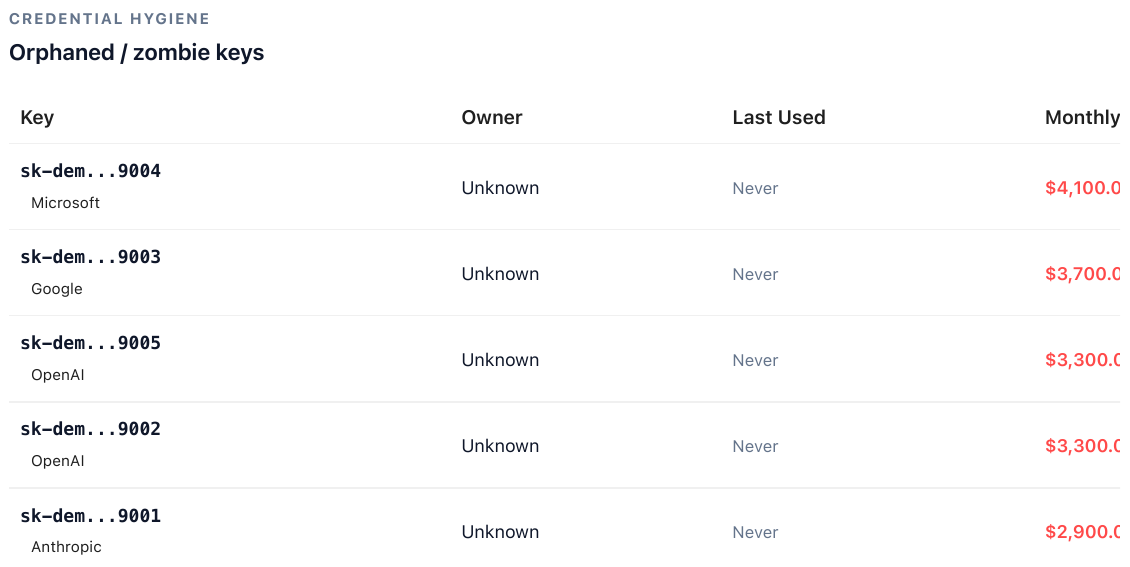
Find unowned agents and orphaned keys.
Shown: XOPS Asset Intelligence, product demo.
Coverage, not a pilot
The operating properties required to govern AI across a complex enterprise estate.
200+
Enterprise & AI integrations
4
Major AI providers covered
Continuous
Enforcement, not alerting after the fact
Above your stack
Deploys on the systems you already run
Choose one department, one agent framework, or one AI vendor renewal. Connect the relevant systems. Establish the AI Position and run one real Outcome before the next steering meeting.