Agents / Infrastructure Manager
An autonomous agent that keeps your infrastructure secure, available, supported and ready for the business. It continuously identifies what needs attention, coordinates the work across your existing tools and teams, and verifies the outcome.
Your team sets policy and makes the critical decisions. The agent handles the work between them.
Your tools find the problems. Your Infrastructure Manager makes sure they get resolved.
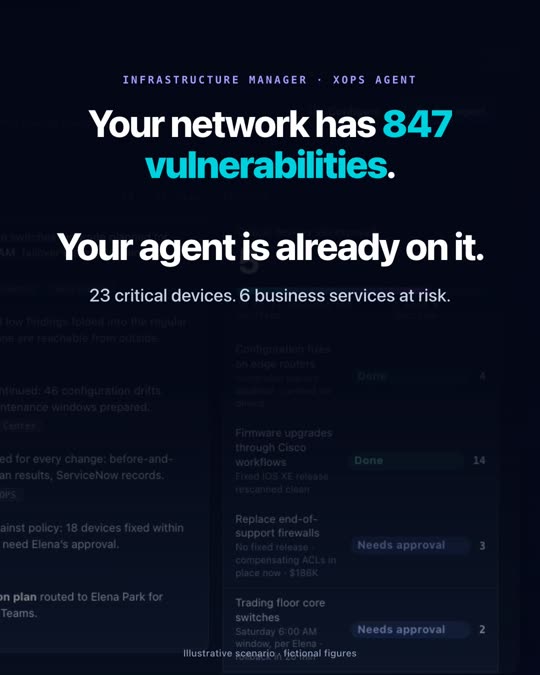
See the agent take responsibility
New security advisory · critical exposure
847 findings across the network
The agent correlates every finding with deployed versions, configurations, business services, policy and the approved remediation options.
23
critical devices
18
verified resolved
2
scheduled for remediation
3
risk exceptions
Illustrative scenario with fictional figures, from the demo video.
The breakthrough isn’t the number of findings. It’s that nobody had to organize the response.
A copilot asks you what to do next.A workforce agent takes the initiative within the authority you delegate. The network owner makes the decisions that require judgment; the agent handles the coordination, execution and verification.
The job description
Infrastructure leaders don’t only worry about vulnerability backlogs. They worry about outages, capacity, unsupported hardware, fragile changes and budgets, and about the coordination between teams that all of it takes. This is the role the agent takes on.
The Infrastructure Manager is designed around six ongoing responsibilities. Customers begin with a defined workflow, validate the operational outcome, and expand the agent’s authority and scope as integrations and capabilities are enabled.
1 · Availability
Spots degraded services, recurring incidents, failing components and single points of failure. Coordinates diagnosis, remediation, vendor support and recovery, then confirms the business service is healthy.
“What is threatening availability, and who is actually resolving it?”
2 · Security
Correlates vulnerabilities with deployed versions, exploitability, exposure and business criticality. Coordinates approved remediation, renews certificates before they lapse, keeps exceptions and compensating controls current and verifies each fix independently.
“Which critical exposures remain, why, and what is being done?”
3 · Lifecycle
Knows what is deployed, who owns it, its support and warranty status and which services depend on it. Coordinates upgrades, RMAs, redeployment, procurement, modernization and retirement, on support status rather than age.
“What needs replacing, what can safely stay, and will the change finish before support ends?”
4 · Capacity
Correlates utilization, reliability, application demand and planned business growth to find constraints before they disrupt a service. Coordinates approved upgrades, expansion or reallocation.
“Will our infrastructure support the business six months from now?”
5 · Change
Prepares the plan, dependencies, approvals, maintenance window, prechecks, vendor actions and rollback. Coordinates the authorized execution and verifies service health afterward.
“Why does an approved change take five teams and three weeks?”
6 · Investment
Reconciles infrastructure with contracts, support entitlements, utilization and financial commitments. Flags unnecessary purchases and renewals, and keeps the evidence of every completed piece of work.
“Are we spending on the right infrastructure, and can we show what it delivered?”
Under the CA/Browser Forum’s schedule, public TLS certificate lifetimes fall from 398 days to 47 days by March 2029, so a renewal that happened once a year will happen about eight times. The agent renews through the certificate manager you already run, then confirms the new certificate is the one actually served by the endpoint before it records the work as done.
Availability
Monitoring shows intermittent degradation at a regional office, but every system reports healthy. The agent correlates network telemetry, application experience, recent changes, topology and business dependencies, finds the underlying issue, coordinates the approved correction and verifies that people can work normally again. If the cause is failing hardware, it coordinates vendor support, the RMA, scheduling, configuration restore and post-change validation.
Illustrative concept
Security
847 findings become 23 critical devices with owners and services. 18 are fixed and verified on the device, 2 are scheduled into an approved change window, and 3 unpatchable firewalls are held behind compensating controls until they are replaced.
Capacity
A business unit plans to expand a location. The agent combines the growth plan with the site’s infrastructure, utilization, standards, procurement lead times and budget owner, finds the shortfall, gets the expansion plan approved, coordinates procurement and deployment and confirms the site is ready before the business needs it.
Illustrative concept
From signal to completed outcome
Infrastructure intelligence and technical controls
Network and server management, security scanners, observability, certificate managers and cloud platforms
Signals: monitoring alerts, security advisories, end-of-support dates, certificate expiry, capacity trends and business requests
XOPS Infrastructure Manager
Enterprise systems and business processes
ServiceNow, procurement, finance, contracts, asset management, security approvals, business owners and vendors
A completed, verified operational outcome
Nothing is ripped out. The tools that diagnose and control your infrastructure keep doing that. The agent supplies what none of them owns on its own: the enterprise context, the decision, the coordination across teams and vendors, and the proof the work was done.
Read-only
Connects to the systems the first responsibility needs and reports the position. Nothing changes.
Recommend
Proposes each plan with its evidence. Your team approves before anything runs.
Delegated execution
Runs the categories of work you delegate, within policy and inside change windows.
Approvals and exceptions
Critical services, replacements and risk acceptance go to named owners, with the evidence attached.
Autonomous within your policies.Every action is logged, checked on the system it changed and recorded as evidence. Your team controls change windows, critical services and exceptions.
Operational productivity
Less of your team’s time spent investigating, coordinating, chasing approvals, following up and verifying routine infrastructure work.
Avoidable infrastructure cost
Useful life extended where support and operational risk allow, unnecessary support contracts ended, and spares and procurement right-sized.
Reduced operational risk
Critical exposures resolved faster, fewer unsupported production systems, and capacity constraints addressed before they disrupt the business.
What you measure it on
Time to verified remediation
From finding to a fix confirmed on the system.
Findings resolved or governed
Each one fixed, scheduled or held as an exception with an owner.
Critical assets outside vendor support
Driven down before support ends, not after.
Autonomous completion rate
The share of work finished within policy without a handoff.
Capacity readiness
Constraints resolved before the business needs the capacity.
Certificates renewed on time
Renewed before expiry and verified on the endpoint.
Operating objectives you set with us and report from verified evidence. Not guarantees.
Before you hire it
No. They keep finding and controlling. The agent takes what they find through to a verified outcome, using them to do the technical work.
The agent evaluates available mitigations and compensating controls, records the remaining exposure, and routes the replacement or risk-acceptance decision to the accountable owner. The case remains governed and tracked until the approved outcome is verified.
Only the systems the first responsibility depends on, for example the certificate manager, the CMDB, a vulnerability scanner and ITSM. Connectors start read-only, and nothing changes until your team signs off.
More on how deployment, approvals and verification work: Deployment Security and compliance
Pick the job that costs your teams the most coordination today. The agent starts read-only, shows you the position, and takes on work as you delegate it.
Where it stands today.Certificate lifecycle is the first infrastructure workflow in customer validation. The six jobs above describe the full role; ask us which are available for your stack today.
